
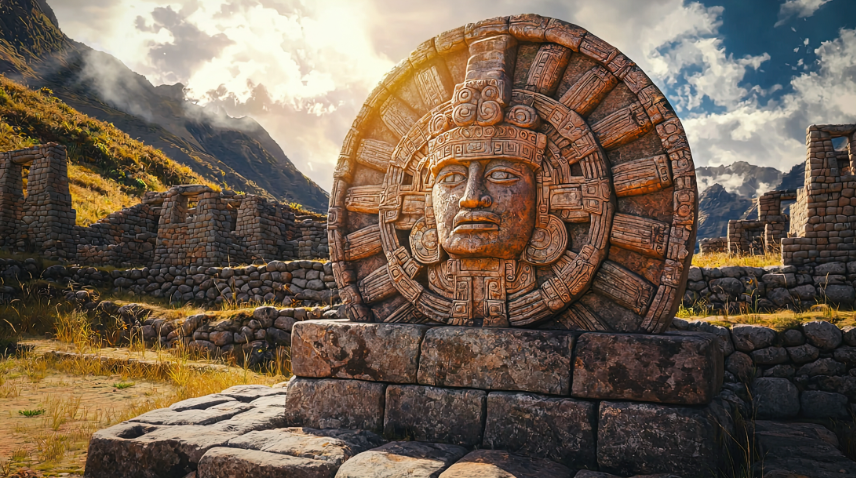
The digital realm has long drawn inspiration from history’s great empires, from sprawling strategy games to intricate puzzle-platformers. Among them was the Inca civilization, a vast and complex society that rose and fell in the dramatic landscapes of the Andes Mountains.
The Inca civilization provides a uniquely rich blueprint for game mechanics, narrative, and world-building. The principles of Inca society, from its legendary engineering to its profound spirituality, offer masterclasses in creating engaging, interconnected, and visually stunning game worlds.
Engineering as Gameplay
The core achievements of Inca architecture and infrastructure translate directly into compelling game systems. The vast network of Inca roads, spanning over 40,000 kilometers, is a ready-made template for open-world exploration and logistics management.
Players must strategically expand their road networks to connect provinces, move armies, and consolidate power, mirroring the strategy of rulers like Pachacuti Inca Yupanqui and Topa Inca Yupanqui.
Similarly, the ingenious agricultural terraces and water management systems of the Sacred Valley are natural resource-management puzzles. Games challenge players to sculpt mountain slopes into fertile farms, optimizing yields in challenging terrain, a direct digital echo of Inca innovation.
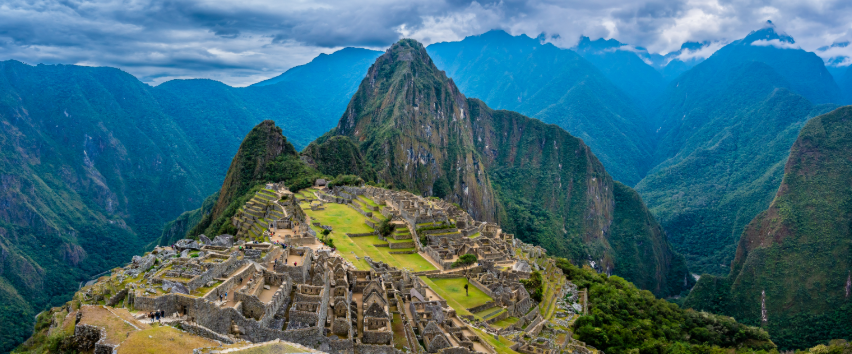
The intrinsic link between environment and mechanics is a key reason many feel compelled to visit Machu Picchu. This enables you to witness the ultimate expression of this design philosophy in stone.
History as Narrative
The dramatic arc of Inca history provides potent narrative fuel. Foundational myths, like the emergence of Manco Capac (also known as Ayar Manco) from Lake Titicaca, serve as epic origin stories.
The rapid expansion, the succession crisis after Huayna Capac, and the tragic Spanish conquest offer branching storylines of ambition and resilience. Characters like Manco Inca Yupanqui, who led the neo-Inca resistance, embody the quest for restoration.
Rituals and geography add challenge. The perilous Capacocha Rituals could frame high-stakes missions, while navigating the vertiginous paths of Huayna Picchu itself functions as a natural platforming or climbing challenge.
The treacherous Inca suspension bridges or the secret Inca Bridge are perfect environmental puzzles. Meanwhile, journeys like the Inca Trail or Salkantay Trek mirror the classic gameplay loop of preparation, arduous journey, and spectacular reward.
Culture as Aesthetic
The distinct visual language of the Inca world elevates game aesthetics. The iconic silhouette of Huayna Picchu is an unforgettable vista. Designers incorporate motifs from Inca artifacts, Peruvian pottery, and vibrant textiles to create authentic assets. A bustling Textile Centre or a chaotic San Pedro Market can be hubs of player commerce.
Incorporating elements of Inca religion and festival life, such as the spiritually charged Qoyllur Rit’i Festival, adds layers of cultural immersion, transforming game worlds from mere backdrops into living entities. This attention to Inca culture and Inca heritage builds respect and authenticity.
The Pilgrimage Loop
The modern experience of engaging with Inca sites mirrors a game’s core structure. The arduous trek to Machu Picchu, whether by the classic trail or via the Hiram Bingham train, is a curated experience of revelation.
Luxury operators like Rothschild Safaris design this journey, much like a game designer guides a player. The principle is clear: the challenge of the journey enhances the payoff of the destination, a cornerstone of environmental storytelling in games.
Design with Ethics
Top-must games move beyond using Inca artifacts as simple loot. They grapple with themes of cultural preservation and colonial impact. A game might involve protecting sacred sites or learning ancient techniques, fostering stewardship rather than exploitation. This reflects a design ethic that treats Inca heritage as a dynamic continuum, not a static historical footnote.
Myth as Mechanic
Beyond the tangible achievements of engineering and the sweeping arcs of history, the Inca worldview itself offers a profound framework for game design. The Inca concept of a living landscape, where mountains (Apus) are deities and natural forces are intimately interwoven with human fate, allows for a seamless fusion of lore and gameplay mechanics.
A player’s actions could directly influence the spiritual balance of the environment. It is where placating an angry mountain god might involve a specific quest chain, altering weather patterns, or restoring a desecrated huaca (shrine).
The foundational myth of the Ayar siblings, emerging to forge a civilization, provides a blueprint for character origin stories and class systems, tying progression to divine mandate and elemental forces. Treating myth as the underlying operating system of the game universe allows designers to create worlds that feel inherently mystical, coherent, and deeply interactive.
The Bottom Line
The Inca civilization endures in game design because its core tenets are interactive by nature. It was an empire built on interconnected systems, awe-inspiring challenges, and a deep harmony with a formidable environment.
These are the very foundations of engaging gameplay: system management, obstacle overcoming, and environmental mastery. The Inca legacy teaches that the most compelling virtual worlds are those built, like the empire itself, with a profound understanding of structure, story, and the sacred relationship between people and place.